
Dreaming Together While Awake
From Personal Waking Dreams to Guided Dreaming for Individual and Collaborative Problem-Solving

We live in an era of intense political and ideological divisions. Discourse has turned into tribal conflict, while social media amplifies outrage, hindering collaborative efforts on shared challenges like climate change and pandemics. Traditional methods of resolving differences—such as debate and compromise—fall short when we hold on to fixed positions, restraining empathy.
To break this cycle of fear and distrust, we must go beyond mere dialogue; we must dream together while awake in search of collective insights and solutions.
Dreaming while awake involves having waking dreams.
According to the APA Dictionary of Psychology, waking dreams are dreamlike mental episodes that occur when one is not asleep, encompassing visions and hallucinations.
Waking dream phenomena, including those of Joan of Arc, Nikola Tesla, Salvador Dali, and Harriet Tubman, are well documented throughout history.
Although waking dreams often lead to genius breakthroughs, Western medicine and psychiatry tend to treat them as maladaptive or even pathological, resulting in fear and stigma.
In contrast, indigenous cultures around the world value waking dreams and have developed various methods, such as meditation, hypnosis, Yoga Nidra, vision quest, and shamanic ceremonies, to name a few, to incubate waking dreams for healing, problem-solving, and spiritual transcendence. Carl Jung’s method of active imagination is a contemporary example of interacting with the unconscious while in a state of wakefulness that can lead to self-discovery and personal growth.
Waking dreams feature an altered state of reality, where sensory details feel intensely real and critical judgment is back-seated. They blur the lines between internal thoughts and external sensations, resulting in fluid, non-linear cognition.
Emotions play a dominant role, guided by symbolic meanings rather than rationality. Although some waking dreams can be initiated voluntarily, their content often feels spontaneous, with individuals sometimes experiencing a reduced sense of control and an altered self-perception, feeling merged with their surroundings or embodying different entities.
An Unlikely Beginning: Pain, Pandemic, and an Octopus Guide
I started my waking dream practice during the COVID-19 pandemic, when I struggled with chronic shoulder pain triggered by the stress of being a homeschooling mom entrepreneur. Seeking relief through hypnotherapy, I experienced vivid, waking dreams of a gentle octopus underwater.
It shape-shifts into a luminous healing bubble where I dissolve in light, prompting me to release my tension and pain. This intuitive coping eventually evolved into Guided Dreaming—a repeatable technique combining dream incubation with the underwater waking dream prompt.
My ongoing practice and research demonstrate that this method not only helps individuals overcome personal challenges but can also foster collaborative problem-solving within groups.
Observing the Process: Water as a Cognitive Catalyst
In my early personal waking dreams, I discovered that the sensory qualities of the underwater environment served as cognitive disruptors. This feeling is something all humans can relate to, as we experienced it during our time as embryos in the womb.
The pressure provided a sense of containment, muffled sounds quieted my mind, and weightlessness alleviated mental rigidity.
The octopus, with its unique shapeshifting ability, became a teacher for creative adaptation. As my shoulder pain eased, I began using breathwork and visualization to initiate the waking dream trance with the octopus as my guide.
From Personal Practice to Shared Methodology
When I introduced this practice to individuals experiencing burnout or other difficulties, their responses were striking.
An exhausted refugee worker described “joyfully frolicking with a dolphin,” while an immobilized senior experienced “walking under the ocean behind blue seahorses.”
These fascinating accounts led me to develop Guided Dreaming into a structured method based on three key pillars:
defining a specific problem,
imagining a helper for added support, and
visualizing an underwater dreamscape with the octopus to harness personalized, transformative insights.
Validation Guided Dreaming Through Academic Research
While developing Guided Dreaming, I returned to graduate school to pursue a master’s degree in health psychology. For my thesis, I conducted a mixed-methods phenomenological study with eleven diverse, self-selected adult volunteer participants, which I presented at the 2024 joint conference of the International Association for Analytical Psychology and the Catholic University of Freiburg in Germany.
Each participant chose a unique challenge, such as a career transition, a relationship breakdown, or an illness. Their survey responses indicated that the octopus’s fluid presence helped participants bypass rigid thinking while the sensory immersion of water reduced analytical interference.
All participants reported experiencing vivid waking dreams that reflected their unique waking circumstances. Notably, 91% achieved actionable insights relevant to their challenges, and their average self-assessed mental outlook improved by 36%.
These findings demonstrated that waking dreams reflect each person’s current circumstances, concerns, emotions, and experiences, consistent with the Continuity Theory on sleeping dreams. Furthermore, they also contain problem-solving insights, similar to sleeping dreams.
Additionally, this research establishes Guided Dreaming as an evidence-based waking dream method effective in stress reduction and problem-solving.
A Pivotal Case: Translating Insight into Action
One participant’s experience exemplifies the depth of the Guided Dreaming method. A burnt-out LGBTQ2S activist, who manages a non-profit health center for unhoused people, experienced water moving through their body rather than against it, allowing them to channel the water freely.
This sensation of flowing water stood in stark contrast to their waking life, where they felt stuck and drained. As a result, they decided to make career choices that would replicate the feeling of freedom.
This somatic-symbolic insight prompted redirection of their energy toward achieving a healthy work life.
This case illustrates Guided Dreaming’s distinctive capacity to address complex psychosocial dilemmas at their core, transcending cognitive understanding to catalyze meaningful change in the real world.
Scaling to Collective Crises
As I prepared to facilitate a dream group each morning during the four-day 2025 IASD virtual conference, I wondered: Could Guided Dreaming also tackle shared systemic challenges?
Adapting Guided Dreaming for collaborative problem-solving required shifting from individual struggles to unifying group intentions, unveiling new possibilities for addressing complex global issues. I planned to give it a try on the third and final day to familiarize the group with the method at the beginning, but the participants changed from day to day.
Global Conflict Resolution: Symbols for Peace
Leading a small, diverse group of mostly strangers, I asked, “How can we overcome escalating global conflicts and wars?” I chose this topic because it affects everyone, regardless of their background. From the Guided Dreaming experiential, participants shared what they “saw”:
a purple tornado revealing explosive chaos
an underwater volcano releasing suppressed anger while birthing new land
calm starfishes capable of self-healing and regeneration
an electric eel illustrating self-generating power
After the session, I created an AI image incorporating these symbols, deepening our understanding of the chaos and violence we face while igniting hope for new beginnings. One participant noted that the underwater volcano symbolizes that destructive power can also be creative, sometimes necessary for larger solutions.
Confronting Climate Crisis: Embodied Environmental Protection
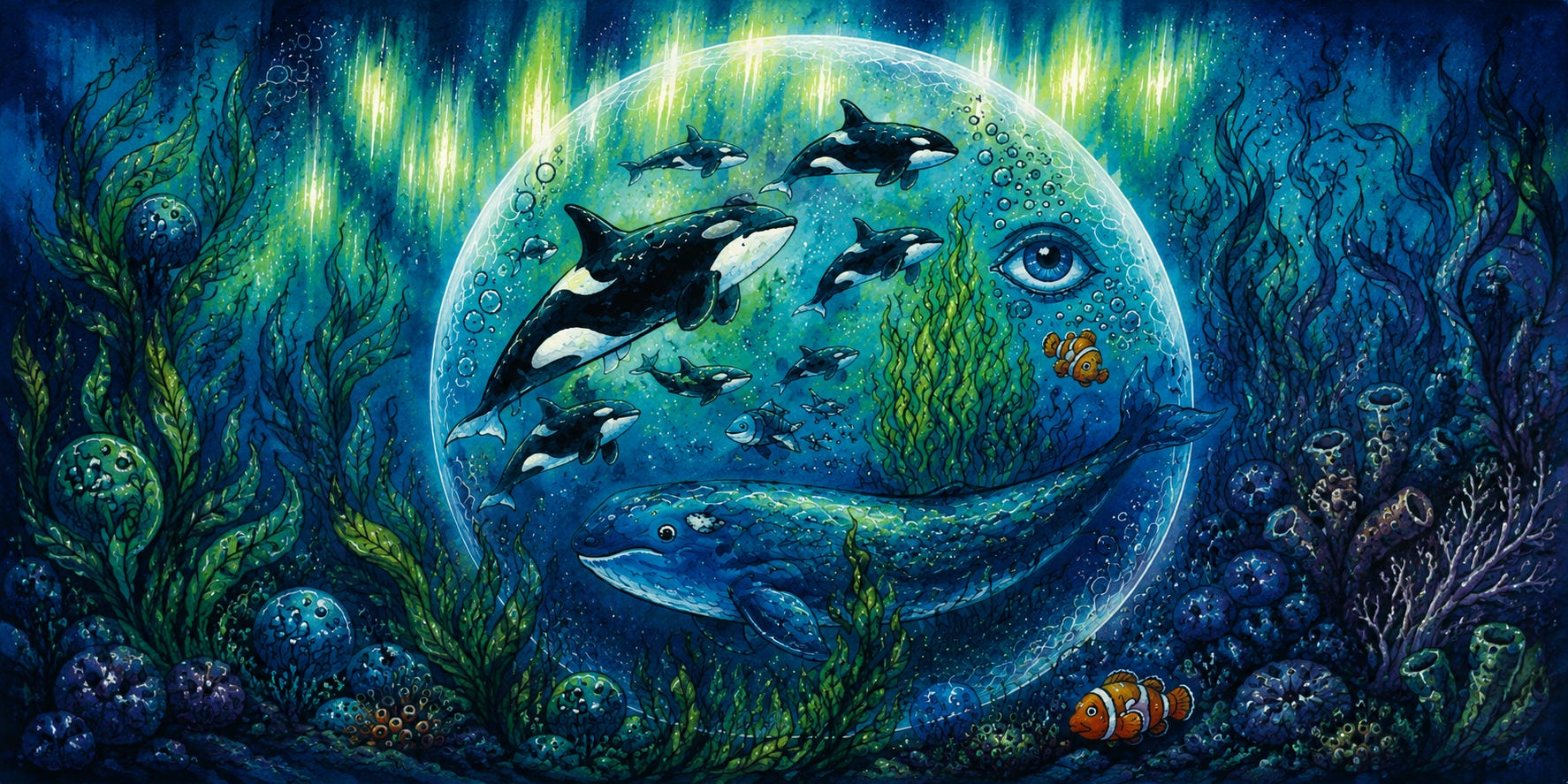
With my last morning dream group, we explored another seemingly impossible challenge: “How can we overcome the climate crisis?” Symbols surfaced with visceral coherence:
a pod of orcas reflected intergenerational coalition
an ancient whale embodied enduring ecological wisdom
Nemo navigating seaweeds captured bravery and hope amidst loss
A watery eye evoked shared planetary grief dynamically transforming into an expanding aura of global solidarity
the northern lights and expansive ocean evoked a sense of wonder and vastness
Reminding us of the beauty and mystery of nature. Participants themselves articulated this profound narrative arc—from honoring collective grief toward generating shared agency—as an actionable framework for environmental action.
Amplifying Insights Through Technology
Recognizing the fleeting nature of waking dream symbols, I used AI art to create impactful reminders. One participant shared that collective dreaming helped her confront the overwhelming global issues we often avoid– a crucial first step in resolving any problems. This technological integration effectively extended Guided Dreaming’s influence, allowing these symbols to guide ongoing strategic visions and actions.
Conclusion: The Continuum of Awake-Dreaming
My Guided Dreaming journey—from personal refuge to collective meaning-making—highlights an important truth: modern challenges require integrated approaches that engage our full intelligence. My IASD experiments showed that diverse groups can co-create actionable frameworks in just sixty minutes, achieving depth often missed in traditional settings. This experience demonstrated that dreaming together while awake unlocks our capacity to navigate complex crises, transforming personal insights into collective strategies for resilient futures.
Navigating Wider Waters
The octopus that once guided me through private struggles now navigates expanding seas. As I continue my Guided Dreaming practice, I remain a committed learner. Each session reaffirms the core lesson: transformative solutions emerge when we dream and trust the wisdom that emerges from the unconscious.
In that liminal space between waking consciousness and fluidity of dream, we discover our capacity to envision and create futures grounded in insight, empathy, and courageous action.
Interested in learning more about dreams and dream research? Join the global community dedicated to the exploration of dreams and dreaming.
Learn more about membership [HERE]

Originally published in the Winter 2026 Edition of DreamTime Magazine.
Bei Linda Tang is the developer of Guided Dreaming, a waking dream protocol designed for stress reduction and problem-solving. Her work integrates dream science, psychology, and ethical dreamwork to explore the mind’s capacity for self-regulation. She holds an MA in Health Psychology and is the Western Canadian IASD Representative.
 | A guest post by
|